Students lead war against social vices in tertiary institutions
Students of the Strategic Communication and Media Studies Department of Lens Polytechnic, Offa, Kwara State, have embarked on a week-long awareness campaign against indecency and other social vices, reaffirming the institution’s commitment to discipline and moral conduct.
The campaign, which was held across all levels at the institution’s mini campus, was designed to support ongoing efforts by the management to curb examination malpractice, indecent dressing, cultism, cybercrime, hooliganism and sex-for-grades practices within the academic environment.
According to information released on Sunday by the institution’s Public Relations Unit, the initiative was spearheaded by students under the supervision of their lecturer, Mr Ayeni Brown, as part of efforts to promote responsible conduct and uphold institutional values.
The sensitisation exercise saw students move from one lecture hall to another throughout the week, engaging their colleagues on the dangers of social vices and the need to embrace decency and good conduct.
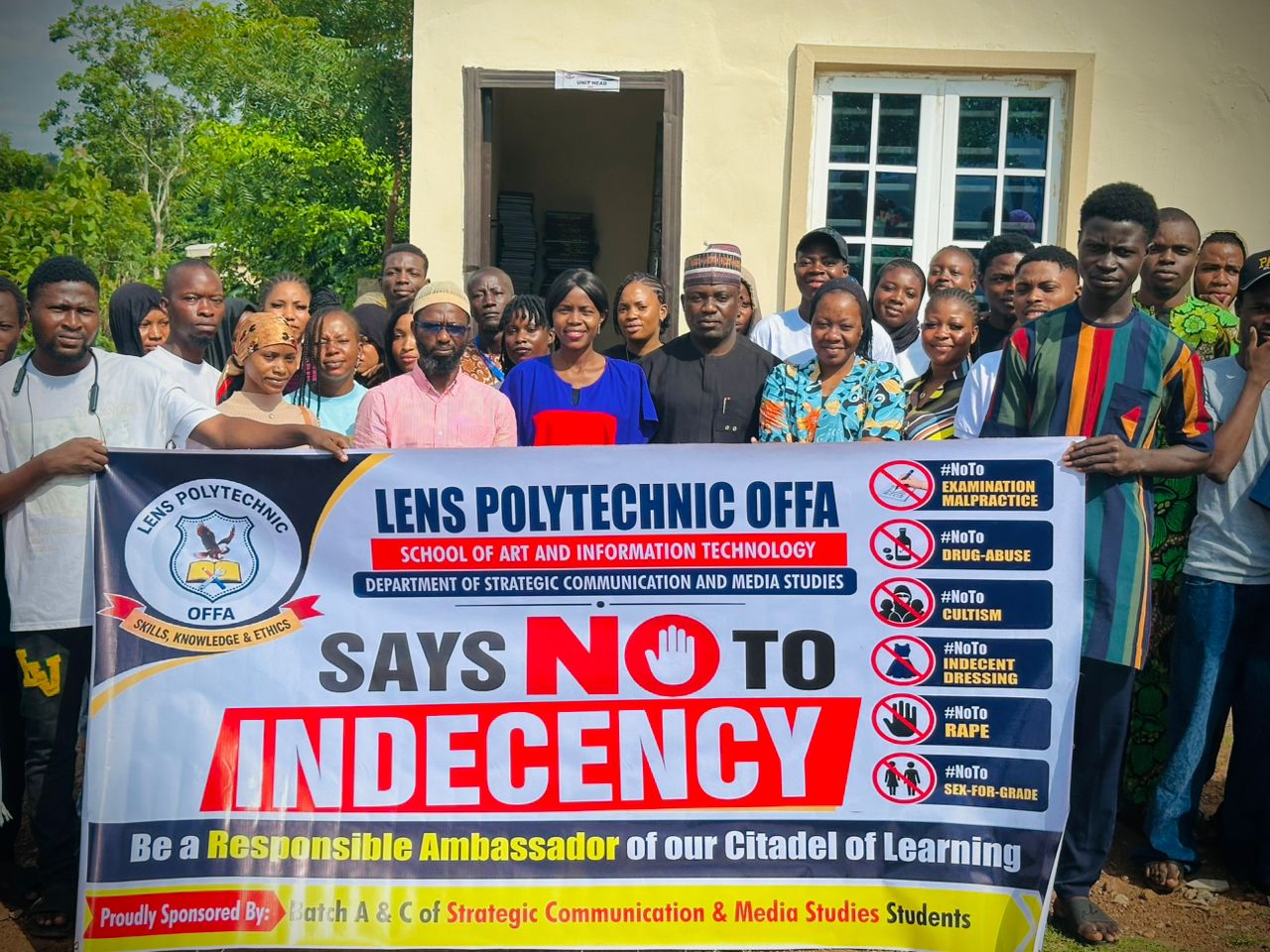
The campaign climaxed with the erection of a large billboard carrying anti-indecency messages at the mini campus.
Speaking on the initiative, the Rector of the Polytechnic, Dr Mrs Mulikat Bolajoko Aliyu, described the campaign as a practical demonstration of learning and a timely intervention against moral decadence among students.
“This campaign against indecency is an excellent practical for an academic environment and beyond. We need to constantly encourage our students because they need counselling. Some students’ acts of indecency are mostly influenced by peer pressure,” Aliyu said.
“Rather than expanding the scope of indecency, instead, counsel your fellow students to shun any form of indecency and be good ambassadors of our citadel of learning and the society at large,” she added.
The rector also commended the students, lecturers and coordinators involved in the project for what she described as an impactful initiative.
“On behalf of the proprietor of the institution, Dr Yiza AbdulAzeez, the Governing Council, principal officers, staff of various departments and all students, we say a big thank you for this impactful campaign to the coordinator of practical, lecturers and the students in the Department of Strategic Communication and Media Studies,” she stated.
Also speaking, the Head of Department of Mass Communication, Adebayo Adedimeji Lukman, said the campaign demonstrated the students’ ability to transform classroom knowledge into practical solutions to societal challenges.
“It’s a good feeling that you all embarked on a week-long campaign against indecency from one lecture hall to another. This doesn’t only show your academic excellence in terms of lectures in the classroom, but it also demonstrates how creative you have been in turning what you have learnt into a practicable idea, from writing advertising copy to planning and eventually executing it on a subject that connects with students,” Lukman said.
“My fellow lecturers in the department and I walked this campaign with you because we believe it will positively impact you all in terms of unlearning all forms of indecency and relearning the core values of being a decent person, for the image of our dear institution and to also be responsible citizens in society,” he added.
The HOD urged students to shun examination malpractice, drug abuse and indecent dressing, stressing that such practices do not contribute to academic success or personal development.
“Examination malpractice, drug abuse, indecent dressing and others do not make any student better. I beseech you to study well and be of good conduct during your examinations, dress neatly and decently, do away with hard substances because they are damaging to health, and be of good conduct wherever you find yourself,” Lukman said.
The institution noted that it has maintained a zero-tolerance stance against indecency and social vices, adding that the campaign forms part of broader efforts to strengthen moral values and responsible behaviour among students.