Investigation: How ignored early warnings, reactive responses are worsening security in Kwara
In Nuku, Kaiama Local Government Area of Kwara State, the night does not usually break suddenly. It thins.
First, the wind settles over the fields. Then the distant sounds from the forest begin to fade, leaving behind a quiet so complete that even the smallest movement feels amplified. By that hour, most homes are deep in sleep, doors bolted, lanterns long extinguished.
But on that Friday, the silence did not fade. It was interrupted.
A low rumble crept in from the edge of the forest. Faint at first, then gathering weight. Motorcycles. Not one. Not two. Many. Moving together, deliberate, cutting through the stillness in a way that did not belong to that hour.
For some residents, the sound triggered a memory only days old. Days earlier, there had been warnings.
A voice note had circulated widely, passing from phone to phone among residents and local security watchers. It warned that armed men were planning to strike the Forest Guards base at the edge of the community. The message spread quickly, but like many warnings before it, it sat uneasily between fear and disbelief.
Some took it seriously. Residents say the Forest Guards went on alert. Others dismissed it as another rumour in a region where fear travels as fast as fact.
By 3:45 a.m. on Friday, the warning became reality.
Dozens of armed men, estimated by locals to be no fewer than 40, emerged from the surrounding forest and converged on the Forest Guards post at the entry point of Nuku. The attack was swift and calculated. Gunfire echoed through the darkness for nearly an hour.
When it ended, five Forest Guards lay dead, including their commander. Two attackers were also killed. Even in retreat, the gunmen moved with precision, carrying away the bodies of their fallen and disappearing back into the forest before reinforcements could arrive.
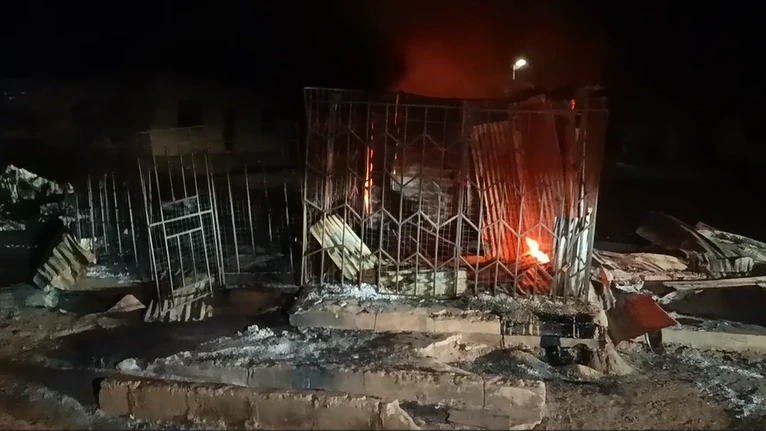
Patrol vehicles belonging to security officials were set ablaze.
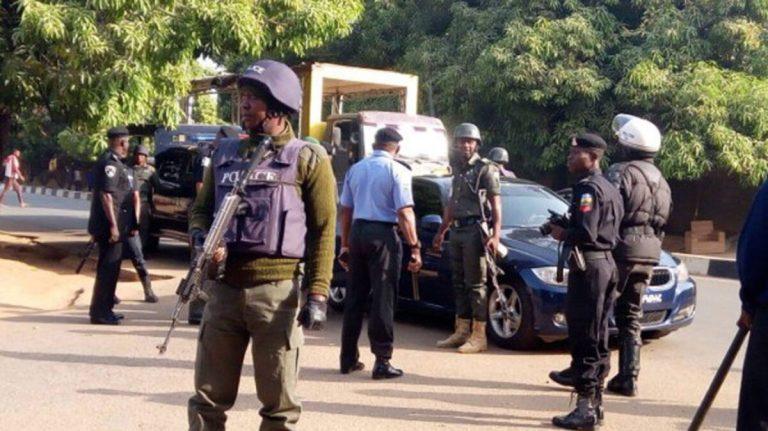
By morning, soldiers had taken over strategic locations. A dusk-to-dawn curfew was imposed. On the surface, the order returned. But for residents, the question lingered longer than the smoke: Why was the warning not enough?
The pattern before the bloodshed
The attack in Nuku comes against a backdrop of worsening insecurity across Kwara State.
Data obtained by the International Center for Investigative Reporting from the Armed Conflict Location and Event Data Project show that between January 1 and November 7, 2025, at least 207 people were killed in the state, including 84 civilians.
Within the same period, 177 people were abducted, with the highest number of cases recorded in Ifelodun, Pategi, Kaiama, Irepodun, and Oyun local government areas.

The violence has been linked to armed groups operating in forested areas along the Niger–Kwara axis. Analysts warn the region is emerging as a new front in Nigeria’s expanding insurgency.
Residents and local officials have repeatedly raised concerns about delayed or absent security responses during attacks. Some accuse authorities of failing to act on prior warnings about militant movements.
Those warnings come in different forms. Sometimes letters are dropped in public places. Sometimes, anonymous messages are sent to traditional rulers. Other times, as in Nuku, voice notes are shared across informal networks.
In some cases, the warnings are acknowledged. Meetings are held. Alerts are raised. But what follows often falls short of sustained preventive action.
In Nuku, residents insist the Forest Guards were not caught unaware.
“They had information. They were waiting,” one local source said. But when the attackers struck, they came in numbers and with coordination that overwhelmed the ground defenses.
“It is not that there was no warning,” another resident said. “It is that nothing strong enough was done with it. The forest guards tried their best, but a quick reinforcement by security officials would have changed the story.”
Residents say this gap between intelligence and action is where the real danger lies.
Security forces often arrive after attacks. They secure areas, mount roadblocks, and conduct patrols. But these measures, residents say, are reactive.
“They come when the damage is done,” a community elder said. “Then they leave when we are still afraid.” The cycle is now familiar: warning, tension, attack, deployment, withdrawal, silence. Then another warning.
Woro and the warning that came too early
Previously, terrorists have attacked the Woro community also in the Kaima Local Government Area. The attack left over 100 people dead.
Weeks before the massacre, a letter was delivered to the district head of Woro. It informed him of an armed group’s intention to “come and preach” in the community.
A community leader in Kaiama, who spoke on condition of anonymity, said the message was taken seriously. The district head forwarded it to the Emirate Council in Ilorin, and security agencies were alerted. Soldiers were deployed to Woro.
For a time, the system appeared to work. But when no attack followed immediately, the troops were withdrawn. The armed group had not disappeared.
“They went to Baburasa and preached there about three weeks ago,” the community leader said. “They even mentioned communities they planned to attack, but they did not mention Woro.”
Then the attack came.
A night of terror
It began around 5:00 p.m. on a Tuesday.
Gunmen arrived on motorcycles and moved methodically through Woro and nearby settlements. What followed lasted nearly 10 hours.

They went from house to house, setting homes and shops ablaze, shooting residents at close range, and abducting women and children.
In one widely reported account, attackers entered a mosque, called for prayers, and opened fire on those who gathered. “They counted 170 this afternoon,” a resident told newsmen from hiding, referring to bodies recovered by a search team escorted by military personnel and forest guards.
Authorities confirmed at least 162 deaths. Residents insist the toll is higher.
Among those killed was Salihu Ibrahim, a former students’ union leader of the Kwara State College of Nursing, Ilorin.
“They razed houses and shops, including the palace of the district head,” another resident said. “They stole his Jeep and used it to transport some of the kidnapped victims into the forest.”
Many residents remained in hiding the following day.

“We have been in the bush since yesterday,” one said. “The gunfire continued until this morning.”
For many, the most painful part is not just the scale of the violence, but the memory of the warning that came before it.
The state responds, then the cycle resumes
In the aftermath, President Bola Tinubu ordered the deployment of an army battalion to Kaiama Local Government Area under “Operation Savannah Shield”.
“It’s commendable that the community members, even though Muslims, refused to be conscripted into a weird belief that promoted violence over peace and dialogue,” he said.
The President urged collaboration between federal and state agencies to provide succour to members of the community and ensure those who committed the atrocities do not go scot-free.
On the ground, however, residents say little has changed. Even after the deployment, attacks did not entirely cease. Nuku, later attacked, lies only a short distance from Woro.
“They deploy after something happens,” a local vigilante said. “They stay briefly. Then they leave.”
The same thing in the South
Further, in Kwara South, Oyun Local Government Area, fear arrived not with gunfire but with a letter.
In the Ira community, a message was dropped at a motorcycle park near the central mosque.
“At first, the riders thought it was a mistake,” a traditional chief said, according to Punch Newspaper. “But after reading it, they took it to the palace.”
A copy of one of the letters was signed by “The Writer (SANUFH).
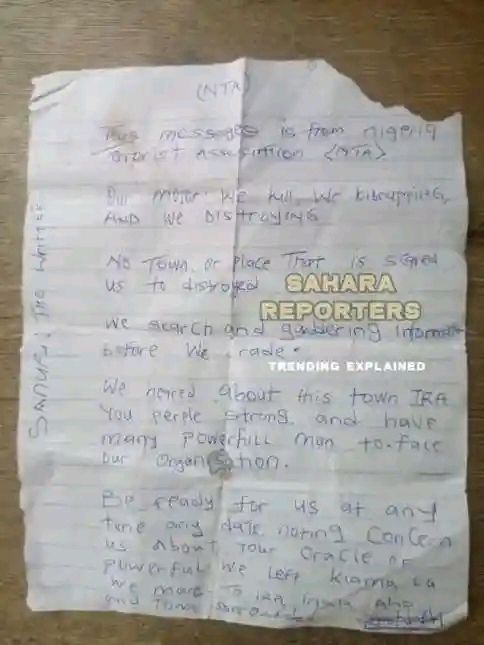
It reads, “This message is from Nigeria Terrorist Association, NTA. Our motor: we kill, we kidnapping, and destroying. No town or place that is scared us to destroy… We search and gaddering information before we rade. We heared about this town Ira, you people strong, and have many powerful man to face our organisation. Be ready for us at any time any date, noting concern us about your oracle or powerful we left kaiama we move to Ira, Inaja, Aho and town around.”
However, despite assurance from authorities, fear spread faster. “This is the first time we are witnessing something like this,” the chief said. “People are afraid. Some have left for nearby towns because we don’t know what is coming.”
Residents fled. Schools shut down. Farmers stayed away from their fields. “There is panic everywhere,” said Yekini Olarewaju, National Secretary of the Ira Descendants Union.
Traditional rulers also raised concerns. “The letter heightened tension and forced some residents to flee,” said the Oninaja of Inaja. “People are scared because of what happened in Kaiama.”
Huge security votes, no evidence of spending
A review of the financial records of the most-affected Kaiama Local Government Area showed that it received N209,922,400 in security votes in 2025. Yet there was no record of spending on security equipment within that period.
The council budgeted N20 million for the purchase of security equipment, but made no expenditure under that heading in the year.

There were also no records of investment in patrol vehicles, surveillance tools, communication devices, or other crime-prevention infrastructure. No spending was recorded on community policing initiatives or support for security agencies.
Security votes in Nigeria are discretionary funds that are often criticised for weak accountability and a lack of transparency.
When contacted, local authorities did not immediately respond to requests for comment.
This investigation was produced with support from Civic Media Lab