FEATURE | ‘Must not be older than 25’: How age restriction worsens job opportunities for Nigerian graduates
It has always been Olaniyi Olanrewaju’s dream to pursue a career in the banking sector. When the opportunity finally came, it was a graduate trainee role—eager to apply, but after reading the application requirements, he realised the job wasn’t for him, not because of his academic qualification or experience, but his age.
The job application required applicants to be between 22 and 27 years old after completion of the National Youth Service Corps (NYSC).
At the time, Olarewaju was already 29 years old, two years older than the required age. Despite the age limit, he applied with little hope of getting a response, even though his curriculum vitae (CV) shows he had skills and experience.
After several attempts to apply for graduate trainee roles, he finally moved on to focus on something else, dashing his hope of starting his career in the banking industry.
“I got one or two interviews, though I didn’t meet the minimum age, but I still applied. After the interview, they didn’t reach out, so I stopped and focused on other things,” he said.
For thousands of graduates in Nigeria, securing an entry-level role or graduate trainee role requires meeting strict age-limit rules, usually under the age of 30.
Age restrictions in job applications remain a common practice across sectors in Nigeria. Research conducted in 2025 across seven African countries, including Nigeria, shows that 15% to 20% of African jobs carry age restrictions.

Sterling Bank graduate trainee programme 2026 showing an age requirement under the age of 26 years

Union Bank graduate trainee programme 2026 showing an age requirement under the age of 27 years
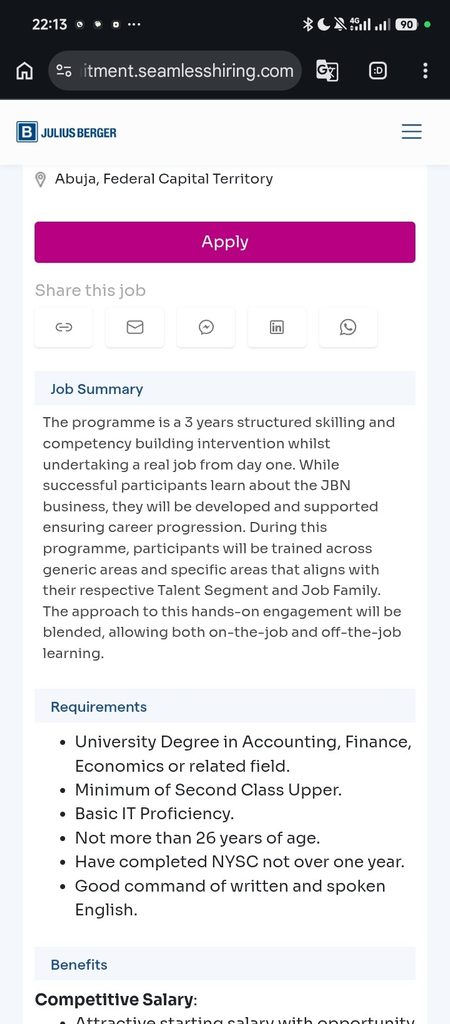
Julius Berger Nigeria graduate trainee programme showing an age requirement under the age of 26 years

According to the Bureau of Public Service Reforms, Nigeria’s youth population eligible to work amounts to 40 million, out of which only 14.7 million are fully employed and another 11.2 million are unemployed.
Age as a proxy for career stage
Samira Nyong, a human resources and people operations manager, said employers assume someone above a certain age should already have work experience, when graduates at 26 or 27 may still be applying for their first formal job, not because they lack ambition or have deliberately delayed their career.
In Nigeria, ASUU strikes, academic disruptions, delayed admission, financial difficulties, and other circumstances have prolonged students’ academic years.
Infographics showing ASUU strikes since 1999
She said that for entry-level and graduate trainee roles, it is often assumed that employers are recruiting young graduates who are just entering the workforce and can be trained and developed within the organisation, which thus gives priority to younger applicants.
“For most entry-level roles, the more relevant criteria should be the candidate’s qualifications, skills, competencies, willingness to learn, and potential to perform the job,” she said.
In a research paper titled “Productivity in older versus younger workers: A systematic literature review,” it was found that 41% of studies showed no productivity differences between older and younger workers, indicating age may not impact productivity.
No legal framework against age restriction in Nigeria
In 2019, the House of Representatives passed a bill to stop various government Ministries, Departments and Agencies (MDAs) from denying eligible and qualified applicants employment on the grounds of age. The bill passed the first and second readings but has yet to be passed into law.
Idoko Josephine Joseph, an associate at Sammie Somiari SAN & Associates, explains that the Nigerian Labour Act does not provide any legislation against age discrimination or restriction in job applications.
She, however, noted that the Act also creates restrictions on underage labour, and women are not allowed to do underground and mining jobs.
Josephine noted that the Labour Act was passed in 2004 and is yet to be reviewed to meet global standards. Sometimes relies on the National Industrial Court of Nigeria on matters the Labour Act does not cover.
She further explained that section 42 of the 1999 Constitution also does not explicitly state age as a form of discrimination, thus granting employers the liberty to set age requirements for employment.
The Nigeria Mental Act, passed in 2021, also aimed at addressing discrimination in employment and provides people with mental health and substance abuse challenges an opportunity to be gainfully employed; however, age remains a big factor yet to be addressed.
Lessons from elsewhere
Adam Suleiman, an advocate lawyer, said there is growing concern for legislation against age discrimination and restrictions in job applications.
He said despite few job opportunities, graduates still face restrictions which are unacceptable.
The Equality Act 2010 provides a comprehensive framework for age discrimination in hiring, promotion, and the workplace entirely. The law protects citizens of all ages; likewise, the Canadian law also protects job advertisements against directly or indirectly indicating age as a qualification.
The Brazilian constitution also forbids differences in positions, salaries, or hiring procedures resulting from gender, age, colour (not “race”), and marital status, with perpetrators facing up to 5 years’ imprisonment.
The New York City Commission on Human Rights Legal Enforcement (NYCHRL) has enforced a prohibition against employers from directly or indirectly expressing an age limitation in a job posting.
For experts who spoke to Informant247, age discrimination practices should be discouraged, and appropriate laws should be implemented and enforced.