FEATURE | How multiple taxes, regulatory hurdles threaten Nigeria’s small businesses
By Yusuf Abdulbasit Hozaifah
Photo Credit: templars
When Muhammad Sayed retired from the civil service, he decided to invest his savings in a packaged-water business in Ilorin, Kwara State.
Documents reviewed by this reporter show that he registered his business name with the Corporate Affairs Commission (CAC) for ₦10,000. Records from the Federal Ministry of Industry, Trade and Investment also show that an application for the SOFQAD TABLE WATER trademark was filed in November 2016 and accepted the following month.
Acknowledgement of SOFQAD table water
His NAFDAC records show that regulatory payments continued after the initial registration process.
A NAFDAC payment advice dated May 26, 2017 shows that Sayed was billed ₦31,500 for the packaged-water product. The document lists ₦10,000 for inspection, ₦10,000 for laboratory analysis and ₦10,000 for a licence fee, with an additional ₦1,500 listed as five per cent Value Added Tax.
Payment for registration of SOFQAD
About eight months later, another NAFDAC payment advice dated January 9, 2018 shows a further payment of ₦21,000. The document lists ₦10,000 for a follow-up inspection and another ₦10,000 for laboratory analysis/re-analysis, plus ₦1,000 in VAT. It also refers specifically to the SOFQAD table-water product.
Payment for follow up inspection receipt
Taken together, the two NAFDAC documents show ₦52,500 in documented payments between May 2017 and January 2018. This was separate from the ₦10,000 CAC business-registration payment and the costs associated with the trademark application.
Sayed said these official payments represented only part of what he spent on getting the factory running. According to him, transportation, logistics and expenses associated with inspection visits added to the cost of the process.
“I spent almost all my retirement savings trying to make the business work,” he said. “After production started, the costs kept rising and within a few months I had to shut down.”
Sayed could not provide a complete record showing the total amount invested in the factory, the additional expenses he incurred or the precise financial loss from the closure. However, documents reveal that his regulatory payments continued beyond the initial inspection and registration process, including a follow-up inspection and laboratory re-analysis in January 2018.
Nigeria has about 39.6 million Micro, Small and Medium Enterprises (MSMEs), according to the National Bureau of Statistics and Small and Medium Enterprises of Nigeria (SMEDAN). These businesses contribute more than 40 percent of the country’s Gross Domestic Product and account for more than 80 percent of employment. However, studies have identified taxes, levies, poor infrastructure and regulatory costs as major challenges facing the sector.
The scale of the sector means that the cost of compliance can have consequences beyond individual businesses. The 2024 PwC MSME Survey, which examined businesses across 13 sectors and 29 states, found that multiple taxes and levies accounted for 12 per cent of the challenges respondents identified as affecting business growth. In the same survey, 75 per cent of respondents said they paid between one and five taxes or levies in a year, while 13 per cent reported paying 11 or more.
The survey also found that compliance at the local government level was considered particularly burdensome by MSMEs. It cited multiple charges, difficulties coordinating between tax authorities and experiences during collection among the issues businesses encounter.
The findings provide a wider context for the experiences of business owners interviewed for this story, whose accounts involve payments to different authorities and agencies as well as costs associated with obtaining regulatory approvals.
Paying to Remain in Business
At Oja Oba market in Ilorin, Kwara State, Taofeeqah Jamiu said traders encounter several payments associated with operating their businesses.
She identified payments connected to taxation, sanitation, environmental services and market activities. According to her, some payments are made annually, while others are collected at different times depending on the service or activity involved.
Taofeeqah said collections can become more noticeable around June and July, when trading activity may be slower. She said traders sometimes negotiate the amounts with collectors and may not always know how the money is distributed among the different authorities or services.
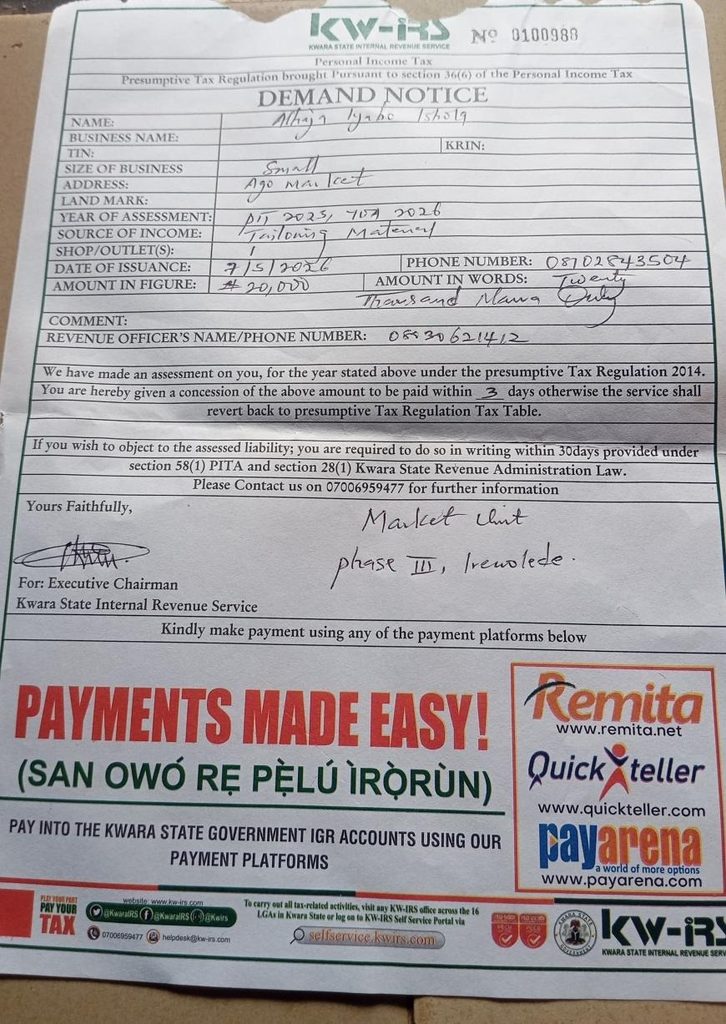
Documents reviewed for this story show that traders and small businesses in the area face different categories of charges. A KW-IRS presumptive tax demand notice reviewed by this reporter shows an assessment of ₦20,000 for a small business. A separate Kwara State Government receipt shows a payment of ₦1,000, while a KWEPA approval sticker reviewed by the reporter shows a payment of ₦500.
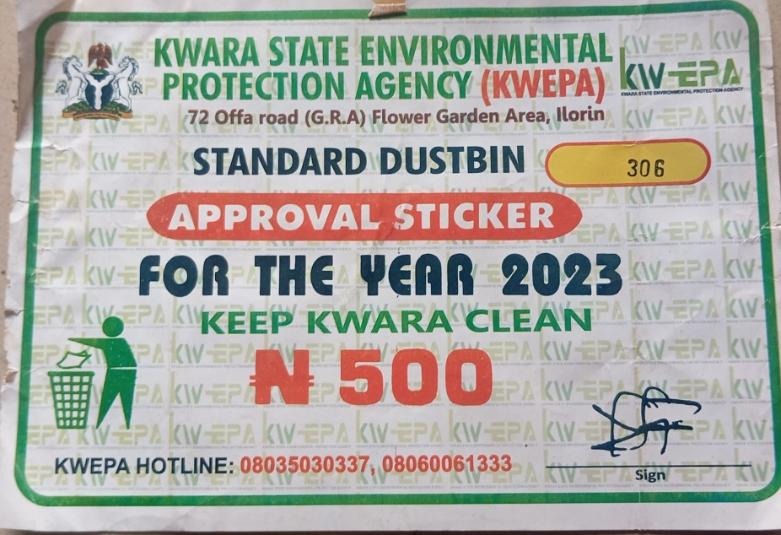
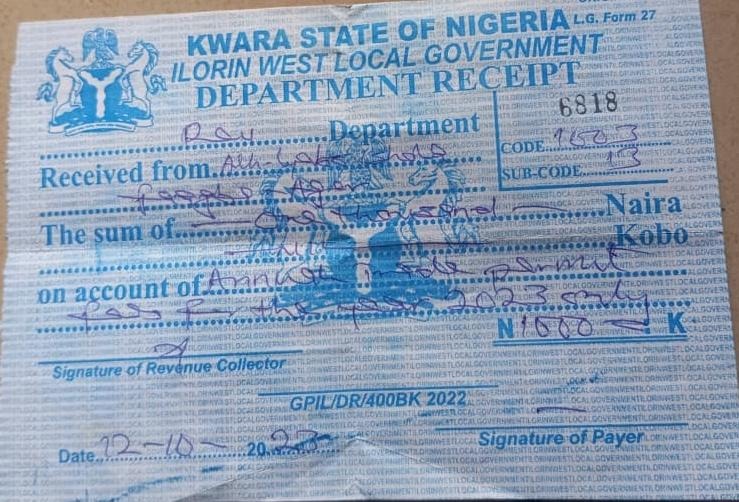
Taofeeqah said she does not consider all the payments unnecessary, explaining that some are connected to services traders require. Her concern, however, is that traders do not always have a clear understanding of how the different collections are calculated or which authority is responsible for each payment.
The Driver Who Changed Routes
For Joseph Adeniyi, a tricycle operator, the cost of operating a commercial tricycle is not determined only by the price written on a ticket. It can also depend on how many times the ticket is demanded during a day’s work.
Adeniyi experienced this difference while operating in Ikorodu, Lagos State, before moving to his current route around Ogijo and Likosi in Ogun State.
He said the regular ticket in Ikorodu costs ₦1,000, but he could be required to pay for the ticket as many as 10 times in a single day, depending on the points along his route.
“When I was in Ikorodu, it’s damn crazy. I can record up to ten tickets,” Adeniyi said.
At the maximum he described, 10 payments of the ₦1,000 regular ticket would amount to ₦10,000 in a day, before considering any other charges or operating expenses. Adeniyi said the repeated payments occurred because there were more collection points along the route.
His current experience is different.
Adeniyi now operates between Ogijo and Likosi, with Arigbabu as his current final bus stop. On this route, he said he normally encounters one or two ticket payments in a day, with two being the maximum in most cases. On some days, he pays only once.
“The place is just one ticket, the council and normal one,” he said, explaining that he receives one payment in Ogijo and another in Likosi.
He said the regular ticket is ₦1,000 per day. He also described another form of collection he encountered on routes where he travelled to and returned from certain locations. According to him, collectors sometimes marked his tricycle with a red marker, with each mark costing between ₦100 and ₦200.
Adeniyi said those red-marker charges are not imposed along his current Ogijo–Likosi–Arigbabu route.
The reduction in the number of payments, however, does not mean that the new route necessarily provides him with better earnings.
Adeniyi said Ikorodu had more passengers and therefore offered more opportunities to make sales. He described the Lagos route as more commercially active than the one he currently operates.
“Ikorodu is inside Lagos and Ikorodu is developed, so there are normally more sales,” he said.
His account presents two different sides of the cost of operating a tricycle. In Ikorodu, he said, there were more opportunities to pick up passengers and make sales, but he could also face repeated ticket collections throughout the day. On his current route, the number of ticket payments has fallen sharply, but so has the level of passenger traffic available to him.
For Adeniyi, therefore, changing routes has not simply meant moving from a place with more charges to one with fewer charges. It has also meant moving from a busier commercial environment to a route where there are fewer opportunities to make sales.
His experience is consistent with wider complaints previously reported among commercial transport operators in the Ikorodu area. In 2022, transport operators complained of multiple charges along the Ogijo–Ikorodu corridor, while a 2024 report documented protests by tricycle operators in Ikorodu over what they described as excessive ticket and marker charges.
Salmanu Mubarak, an engineer working in Sagamu, Ogun State, had also considered starting a popcorn business as an additional source of income.
Mubarak said he began making enquiries about the requirements for producing and selling the product and was informed that regulatory approval from the National Agency for Food and Drug Administration and Control (NAFDAC) would be required.
He said he spent money trying to understand and comply with the requirements but was unable to complete the process.
“I spent money trying to understand the process and make payments, but I could not continue,” he said.
Mubarak eventually abandoned the popcorn business and continued with his employment.
His experience differs from Sayed’s because the business did not reach the stage of sustained production. In Mubarak’s case, the regulatory process became a factor in abandoning a business idea before it was fully established.
Reforms and Realities
The Federal Government has introduced reforms aimed at simplifying taxation for smaller businesses.
Under the presumptive tax framework introduced by the Ministry of Finance, nano and small businesses with annual turnover of ₦12 million and below are exempt from tax, while technology-driven payment systems are expected to reduce informal collections and cash-based enforcement.
Yet, experts argue that the government needs to do more than just legislation on paper. Dr. Bello Audu, an innovation economist and lecturer at Usmanu Danfodiyo University, Sokoto, said frequent and unpredictable payments can affect the ability of small businesses to survive.
According to him, taxes and levies increase business costs and may raise prices, making it more difficult for new entrepreneurs to compete with established businesses.
He said uncertainty around payments can also make it difficult for entrepreneurs to plan, invest and expand.
Dr. Audu added that government policies should ensure that payment systems are transparent, predictable and easy to understand, while businesses exempted under tax laws should be protected from unauthorized collections.
KW-IRS React
Mr. Sakariyah Wasiu, a staff member of the Kwara State Internal Revenue Service (KW-IRS), said the tax system changed significantly with the coming into effect of the new tax laws on January 1, 2026.
He explained that under the Nigeria Tax Act, a small company is one with an annual gross turnover of not more than ₦50 million and fixed assets not exceeding ₦250 million, although certain professional businesses are excluded from the classification. He added that small companies are exempt from Company Income Tax, while companies with annual turnover of ₦100 million or less are exempt from charging VAT. Nano-enterprises with annual turnover below ₦12 million are also exempt from income tax, but businesses are still required to file their returns and comply with applicable obligations.
Mr. WASIU also clarified that Pay As You Earn (PAYE) applies to employees’ income and is deducted from salaries by employers where applicable. This is separate from any tax or regulatory obligations arising from a business an employee may operate.
On concerns about multiple and overlapping taxes, Mr Wasiu said KW-IRS is working with local governments to create a harmonised revenue framework designed to consolidate the different tax and non-tax revenues payable by taxpayers. He advised business owners facing unclear demands to request the official harmonised bill, make payments only through approved government channels and keep proper records of their payments. He also said taxpayers can seek redress through the appropriate KW-IRS channels and, where necessary, the Office of the Tax Ombud established under the new tax administration framework.
_________________
This story was produced as part of the Liberalist Centre’s Journalism for Liberty Fellowship, with funding from Liberty International.