
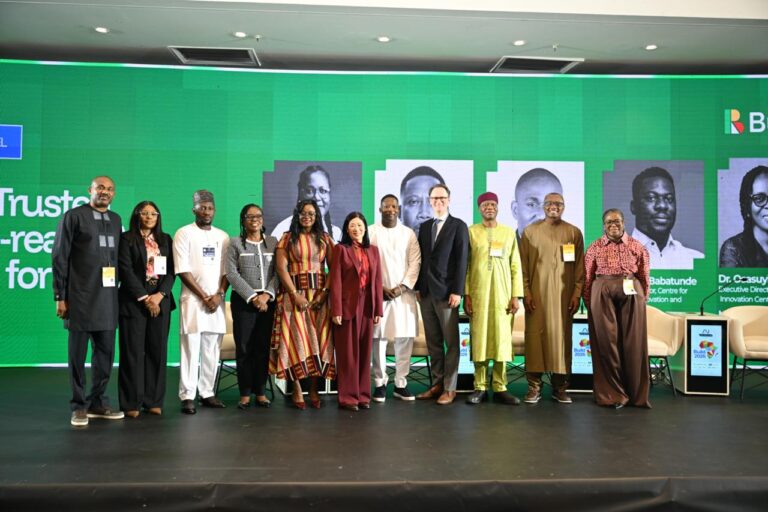
FG proposes shared AI infrastructure with Rwanda, Senegal, Kenya
The Federal Government has proposed a shared artificial intelligence (AI) computing infrastructure with Rwanda, Senegal and Kenya to strengthen Africa’s capacity to develop and run AI models.
Bosun Tijani, minister of communications, innovation and digital economy, disclosed this on Wednesday in Abuja at the Build 2026 conference organised by the Nigeria AI Collective.
Speaking through Olubunmi Ajala, national director of the National Centre for Artificial Intelligence and Robotics (NCAIR), Tijani said the initiative would enable participating countries to pool their graphics processing unit (GPU) resources to undertake computing tasks beyond the capacity of individual countries.
The conference was themed “Building Africa’s Shared Compute and AI Infrastructure”.
The minister explained that the arrangement would allow researchers and developers across the participating countries to combine computing resources to develop large language models and other advanced AI technologies.
He said Nigeria could connect its GPU resources with infrastructure funded by the Gates Foundation in Rwanda, as well as resources in Senegal and Kenya, to undertake large-scale computing projects.
Tijani noted that Nigeria’s computing capacity might not be sufficient to develop some large AI models independently, but combining resources across countries could make such projects possible within a short period.
He said electricity supply, internet connectivity, cloud computing and access to specialised chips remained major constraints to AI development across Africa.
According to him, about 20 million Nigerians still lack internet connectivity, prompting the government to pursue a fibre-optic expansion programme to improve access nationwide.
Tijani also highlighted difficulties in obtaining advanced AI chips, citing supply constraints, high costs and geopolitical considerations surrounding the technology.
On electricity, he said Nigeria was exploring ways to address power constraints through a proposed Nigeria-Togo data park in Egbe, where about 60 per cent of available power capacity remains unused.
According to the minister, the proposed facility is expected to support computing infrastructure for Nigeria and other parts of West Africa.
Tijani added that Nigeria had improved its position in the Oxford AI Readiness Index, moving from 103rd to 73rd place over two years.
He said the government’s AI strategy aims to place Nigeria among the top 25 per cent of countries in AI readiness.
Osasuyi Dirisu, executive director of the Policy Innovation Centre (PIC), said the conference was designed to bring together relevant stakeholders and innovators to develop practical solutions to Africa’s AI infrastructure needs.
Dirisu said the collective was working towards an inclusive, locally driven approach to Nigeria’s AI initiatives.
The Nigeria AI Collective is funded by Luminate, AI Collaborative, Ford Foundation and MacArthur Foundation.
It is managed by PIC, Lagos Business School, Data Science Nigeria at Pan-Atlantic University, the Centre for Journalism, Innovation and Development, and NCAIR.


