Tinubu seeks World Bank support for improved agriculture, economic reforms
President Bola Ahmed Tinubu has appealed to the World Bank for stronger support for Nigeria’s sweeping economic reforms, with agriculture, youth employment and private sector growth at the heart of his administration’s recovery strategy.
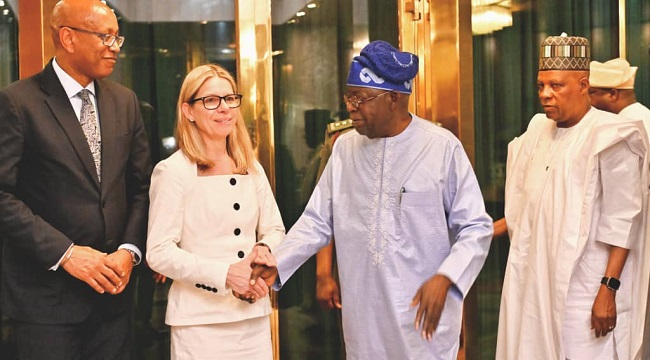
Tinubu made the call on Tuesday at the State House in Abuja while receiving a World Bank delegation led by its Managing Director of Operations, Anna Bjerde. He reaffirmed his government’s commitment to reforms despite early challenges, insisting there would be “no turning back.”
“Since we went into this tunnel of reform, we have our hands on the power and we’re never going to look back,” the president said. “Initially, it was painful and difficult, but those who win are not the ones who give up in difficult times.”
The president identified agriculture as a key driver of inclusive growth, stressing the need for mechanisation and modern farming practices to boost productivity and unlock opportunities for Nigeria’s youthful population, adding that the government is establishing mechanisation centres to provide improved seedlings and fertilisers, while encouraging farmers to move from small-scale operations into larger cooperatives.
“Our goal is to transform agriculture into a modern, productive sector that creates jobs and expands opportunities for Nigerians,” Tinubu said.
Beyond agriculture, the president highlighted the petrochemical industry and other domestic sectors as priorities for increasing local output and strengthening internal markets. He noted that reforms must be continuous and anchored on transparency, accountability and stability.
Acknowledging initial economic pressures, Tinubu said inflation has eased significantly and the naira has stabilised, adding that his administration is working to cut red tape, improve the ease of doing business and build skills for a competitive workforce.
Commending the reform drive, Bjerde described Nigeria as a global example of sustained reform implementation, noting that the consistency of the Tinubu administration has boosted investor confidence.
“The results achieved in the last two years are commendable,” she said. “Your steady communication of the importance of reforms has given confidence and clarity, and there is no turning back.”
She emphasised job creation—especially for young people—as a critical priority, noting that agriculture remains a major employer across Africa. According to her, innovations in mechanisation, cooperatives, value-chain development and infrastructure can be scaled to generate more jobs.
Bjerde also outlined the World Bank Group’s financial support for Nigeria, including $17 billion in public sector financing, $5 billion in private sector support through the IFC, and over $500 million in investment guarantees. She said the funding aligns with Nigeria’s reform agenda in areas such as trade, digital development and inflation management.
“We want to work with Nigeria to accelerate growth, expand access to finance for SMEs, and support early childhood development as part of a broader human capital strategy,” she added.
The meeting highlighted Nigeria’s renewed push to leverage international partnerships to drive reforms in sectors critical to youth employment, food security and long-term economic growth.