The show-off race: How Kwara big guys tried to outplay one another during APC convention in Abuja
Over the weekend, the All Progressives Congress (APC) held its national convention, a gathering that, on paper, followed a familiar script. Earlier congresses at the sub-national level, from states to local governments and wards, had been conducted with little friction, largely due to the party’s adoption of a consensus arrangement that returned many incumbent officeholders. In most states, it was a seamless process.
The national convention did not deviate much from that pattern. The directive had gone out: most executives were to return unchallenged. Contests were minimal, opposition even rarer.
The Minister of Information and National Orientation, Mohammed Idris, described the convention as a defining moment for the party, one that would bring together delegates from across Nigeria’s 36 states and the Federal Capital Territory for leadership decisions, policy conversations, and strategic alignment.
“The convention is not just a routine exercise, but a moment of reflection, consolidation, and forward planning. It represents our collective resolve to strengthen democratic values, deepen internal governance, and align party processes with national development priorities,” he said.
Yet, beyond the official rhetoric, the reality on ground told a more layered story. For many delegates, the convention was less about decision-making, as those had largely been settled, and more about presence, pageantry and projection.
Draped in flamboyant attires, party faithful turned Abuja into a theatre of colour and class, rivaling even the most extravagant social gatherings. It was, by all accounts, one of the most elite congregations in recent Nigerian political history. The President, Vice President, National Assembly leadership, members of the Federal Executive Council, 31 governors, and a legion of lawmakers converged in one place.
But while many came to celebrate, network, and be seen, the mood among delegates from Kwara State was markedly different.
For them, this was not just a convention, it was a battleground.
Abuja as the new arena
As other delegates soaked in the spectacle, Kwara’s political actors were locked in a subtle but intense contest, a race not of votes, but of visibility, influence, and proximity to power.
Back home, many of these aspirants are well known to one another. They understand their individual strengths and limitations within the state. But Abuja is a different terrain, one where perception can outweigh structure, and where access often trumps popularity.
Each aspirant came with a clear objective: to demonstrate relevance at the centre. To be seen. To be counted. To signal that when the time comes, they have the reach to secure the ticket.
This strategy did not emerge overnight. It is rooted in recent political history.
The 2019 lesson
In 2019, while many governorship hopefuls busied themselves with grassroots mobilisation across Kwara, touring communities, dominating radio waves, and staging media campaigns, one man chose a different path. The man is the governor today.
AbdulRahman AbdulRazaq kept a relatively low profile within the state, instead shuttling quietly between Abuja and Lagos. He lacked the noise, the visible structure, and the media buzz that defined his rivals. But he understood the game.
While others built local momentum, he cultivated influence where it mattered most, within the corridors of power. When the moment of decision came, he secured the party’s ticket.
Despite initial resistance, other aspirants eventually fell in line, forming a coalition that would go on to dismantle the long-standing Saraki political dynasty.
At the time, Bukola Saraki, the scion of that dynasty, was a formidable national figure. Dislodging him required not just local strength, but a coordinated strategy backed by powerful interests.
Nothing was left to chance, not even the party’s primary ticket. That experience has since become a guiding lesson for Kwara’s political class.
2026: A quiet Kwara, a loud Abuja
Fast-forward to 2026, and the battle lines are once again being drawn, but this time, with a clearer understanding of where the real contest lies.
Within Kwara, activities remain relatively subdued. Occasional displays of wealth and influence surface, but nothing compared to the calculated maneuvers unfolding in Abuja.
The real game has shifted.
No serious aspirant wants to repeat the perceived mistake of 2019, building loud structures at home, only to lose the ticket to a quieter contender with stronger Abuja backing.
So, alliances are being forged, not just within the state, but around the seat of power.
One aspirant is aligned with Bisi Akande. Another draws strength from the Senate President’s camp. Yet another is closely associated with Seyi Tinubu, moving within influential Abuja circles and championing youth-driven political movements.
Elsewhere, loyalties stretch to the President’s wife and ofcourse the defunct ACN structure.
For each contender, the calculation is the same: build enough weight in Abuja to tilt the scales when it matters.
Convention as a stage
Against this backdrop, the APC national convention became more than a political gathering, it became a stage.
While delegates from other states celebrated, Kwara’s governorship aspirants turned the event into a display of strength. Supporters flooded the venue with branded materials, choreographed chants, and carefully curated social media content. A scroll through Kwara-related feeds during the convention painted a vivid picture of this silent contest.
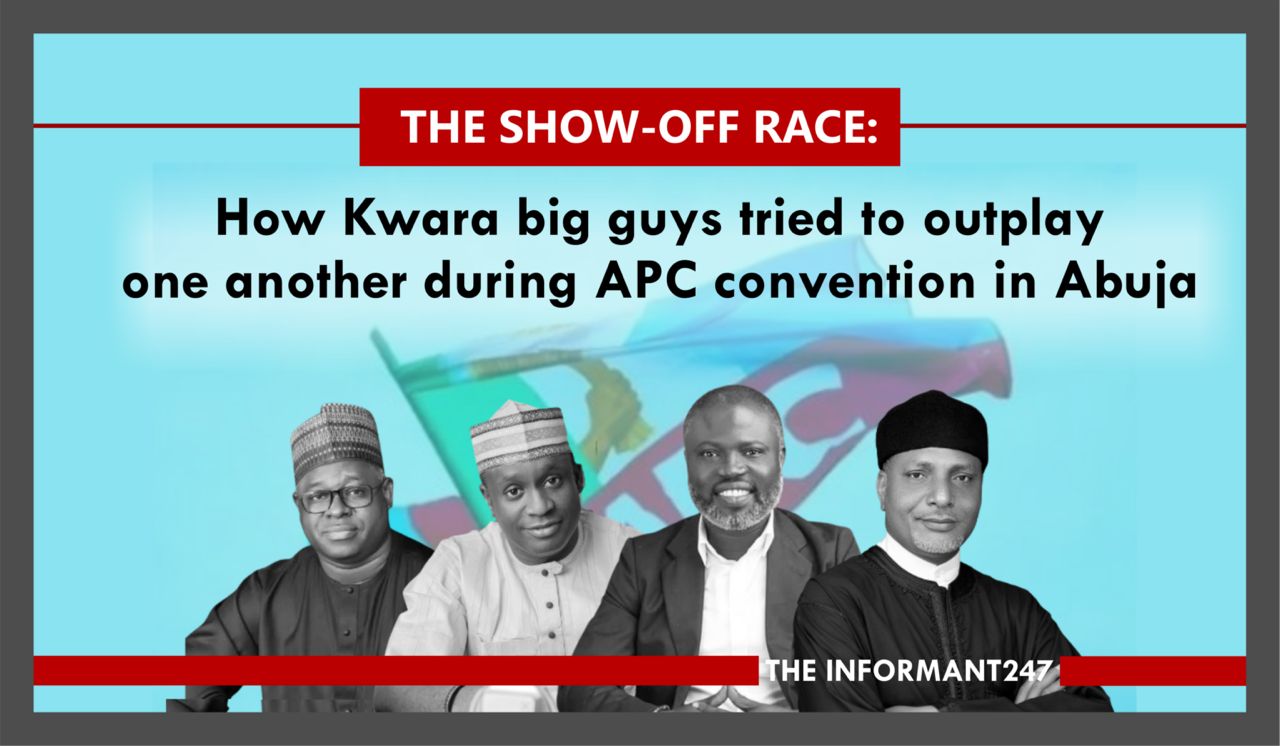
Though many aspirants were present, four stood out in visibility and intensity: Yahaya Seriki, Saliu Mustapha, Sadiq Umar and Salihu Danladi.
Yahaya Seriki: From local player to Abuja force
Once seen largely as a local figure, Yahaya Seriki has, in recent years, reinvented himself as a major player within Abuja’s power circuit.
A billionaire business mogul, some two years back, he was still largely an Ilorin man, not known beyond Kwara and Plateau State, silently mining and building structures in Kwara.
He had his eyes on the Kwara Central senatorial seat in 2023 but lost the primary to Saliu Mustapha. Within his camp, there was a belief that the outcome was influenced by forces outside the state, particularly pressure from Abuja. He was the governor’s favourite then, but still couldn’t get the ticket, that loss appears to now shape his political thinking.
Since then, he has deliberately relocated his base of influence. Today, he moves within elite Abuja circles, leveraging both wealth and access. His mining empire, one of the largest in the country, has become a tool of influence he previously underutilised.
The transformation is visible. He is now no longer the ‘Ambassador’ we know in Kwara; the Gambari-born politician is now seen around the corridors of power, in the company of top figures, including Seyi Tinubu and other key actors.
His Maitama palatial mansion has played host to influential visitors like Oni of Ife, the APC National Chairman and the Secretary to the Government of the Federation (SGF), signaling a man steadily inserting himself into the inner circle.
He is also one of those who championed the creation of one of the largest youth campaign movements for the president’s re-election, all while not forgetting his own ambition of becoming the state governor, the primary purpose of his move to Abuja.
So, for him, he has enough to show in Abuja after over two years of staying there. The convention was the right time to show off, and he indeed did. Videos of him moving with Abuja’s power brokers, supporters adorned in his colours, and choreographed displays of loyalty all reinforced one message: he now has weight in Abuja.
If he isn’t an envious type, Seriki should indeed be a proud boy. He has achieved a lot within his short time in Abuja.
If it were some two years back, he would have been a political orphan in Abuja with no one to look at. If the ticket is today to be decided at the country’s capital city, he holds a big stake.
Saliu Mustapha: The insider with deep roots
If Seriki represents a rising force, Saliu Mustapha is the definition of an insider who has long understood how power moves.
Long before he became a household name in Kwara politics, he was already operating within the national structure. Not many knew, or paid attention to the fact, that the Turaki of Ilorin was among those who appended their signatures to the formation of the APC in 2014. As a member of the CPC bloc under the Buhari tendency, he was part of the original builders of the party. He was not an outsider trying to break in, he has always been in the room.
During the years of Muhammadu Buhari, he remained relatively quiet in public view, but not absent from power. Those who understand Abuja politics knew he maintained strong ties within the northern political establishment and business elite, relationships built over decades, not election cycles.
His emergence as senator for Kwara Central in 2023 did not happen by chance. Within Kwara, there were clear preferences and alignments, and many would argue he was not the first choice of the state leadership. Yet, when it mattered most, pressure from Abuja and his network of influence proved decisive. He secured the ticket and went on to win the seat.
That moment told a bigger story, that his strength does not solely lie in local popularity, but in his ability to activate connections when it counts.
Once in the Senate, he wasted no time reasserting that influence. In the battle for the Senate Presidency, he was not just a participant, he was visibly aligned with the winning camp. Among 109 senators, his positioning stood out. He, in fact, was the only one that rode with the new Senate President on his first day in office. Being consistently seen around the eventual leadership was not by chance, it was a signal of access and trust within one of the most powerful arms of government.
At the convention, that same advantage was on full display. He moved with ease among the political elite, engaging, observing, and reinforcing relationships that have been years in the making. His supporters complemented that quiet strength with loud visibility, from branded buses moving across Abuja to banners that ensured his name stayed in circulation.
His big buses were parading Abuja, and everyone at the convention must recall seeing those buses. One detail, however, stood out more than the colourful banners of him and the president plastered on the buses. It is unusual for anyone to have that kind of political poster without the picture of the governor on it. Not in Kwara. Even during their long, silent battle, the governor’s picture was on his empowerment banners. Now that the ticket is just weeks away from being decided, what has changed?
For Mustapha, Abuja is not a new battleground, it is familiar territory. He understands its language, its timing, and its unwritten rules.
And if, as many believe, the governorship ticket will again be heavily influenced by Abuja, then he is not just in the race, he is standing on very solid ground.
Sadiq Umar: Carrying the North’s expectation
For Sadiq Umar, the ambition is not just personal, it is deeply regional.
Kwara North has not produced a governor since the return of democracy in 1999, and across the zone, there is a growing, almost settled belief that it is their turn. For many political actors from the region, the 2027 race is less about open competition and more about equity.
But beyond the moral argument of zoning, there is a political reality they all understand: sentiment alone does not win tickets. Abuja must be convinced.
Sadiq Umar is not the only aspirant from Kwara North, but he is currently its highest-ranking representative at the national level. That status comes with both advantage and responsibility. If the zone must negotiate power, he is one of those expected to sit at the table.
This explains his dual strategy. Back home, the campaign leans heavily on zoning, pushing a narrative designed to rally Kwara Central and South behind the North. But at the same time, there is a deliberate effort to build weight in Abuja, where the final decision may well be shaped.
The national convention provided the perfect stage for that projection.
It was not just about the familiar handshakes and laughter with fellow senators across the country, though those mattered. It was also about optics, how he was seen, how often he appeared, and how strongly his camp could project him.
His supporters understood the assignment. The 3SU banners were everywhere, bold and coordinated. From the convention ground to the surrounding spaces, his presence was difficult to miss.
Beyond the visuals, there was a clear message being passed: that he is not just a local contender riding on zoning sentiment, but a player with access, visibility, and growing relevance in Abuja.
For a zone seeking its first real shot at power in decades, that distinction matters. And if the convention’s show of strength is anything to go by, Sadiq Umar made sure he was firmly in that conversation.
Salihu Danladi: Strong at home, seeking reach
Salihu Danladi represents perhaps one of the most locally grounded candidates among the frontrunners and according to several informed sources, he is the preferred candidate of Governor AbdulRahman AbdulRazaq.
As Speaker of the Kwara State House of Assembly and one of the leading governorship aspirants, projecting power in Abuja was not optional for him, it was necessary. Yes, the governor will have a significant say, but history suggests that the final call on the ticket may still be influenced, if not determined, from Abuja.
Within Kwara, Danladi is anything but lightweight. He has built a strong grassroots structure across the state and remains one of the most prominent beneficiaries of the growing Kwara North zoning conversation. If that arrangement eventually materialises, he is firmly in the mix of those who stand to gain.
But his influence has limits. As many insiders quietly admit, much of his political strength tends to taper off once it crosses Ilorin International Airport. In Abuja, he is comparatively less known, with fewer entrenched alliances and limited long-standing relationships in Abuja.
That reality is not entirely surprising. Until 2019, he was a relatively young academic at the Federal University of Technology, Minna, with little political visibility. His emergence into the House of Assembly, and eventual rise to Speaker, was largely aided by zoning dynamics and timing. Since then, he has grown into the role, consolidating influence across the state.
Today, he unarguably wields significant control within Kwara’s political space. Among party members and within the governor’s inner caucus, he is the ‘Controller-General’. In fact, he was said to have singlehandedly handpicked most of the party executives and delegates and even picked chairman and councilors for the party during the last local council election.
However, the governorship ticket is a different contest entirely. And as history has repeatedly shown, Abuja always has a say.
The convention, therefore, offered him a chance to compensate for what he lacks in elite connections with visible strength. His supporters showed up in numbers, energised and coordinated. Delegates aligned with him sang his praises, recorded videos, and flooded WhatsApp and Facebook with carefully curated clips to project his presence at the capital city.
He may not yet have the deep Abuja network of some of his rivals, but through his supporters, he ensured one thing, he would not be ignored. And if the Governor has submitted the Speaker’s name anywhere in Abuja as his preferred candidate, the convention show-off just made the work easier.
In a contest where perception can be as powerful as access, he has used the convention to announce, loudly, that he is in the race, and that his structure at home can travel.
A contest without ballots
In the end, the APC national convention delivered what it was designed to, continuity, consensus, and celebration. But beneath the surface, especially for Kwara’s political class, it revealed something more telling: a quiet, calculated struggle for advantage.
There were no ballots cast for the governorship. No official campaigns launched. Yet, in the movements, the symbolism of alliances, and the theatre of presence, a different kind of contest played out, one that may ultimately shape who carries the party’s flag.
Just like in 2019, the real decision for the party ticket may not be made in the open field of local politics, but in the quieter, more consequential corridors of Abuja.