Op-ed | From flagpole to prancing horse: Kwara govt in search of identity
By Uthman Qasim
Symbols are not simply decorations in governance; they are the vessels through which a people’s history, memories, and dreams live on. Symbols embody the essence of identity, passing down values, beliefs, and a sense of collective consciousness. By means of symbols, nations articulate their identities, express their principles, and set themselves their destinies.
Symbols move people emotionally, make them loyal, and unite them in pursuit of their aspirations. And that is why symbols have to be created from the people’s spirit, they have to resonate within their hearts.
It was therefore a moment of deep reflection in 2019 when the Kwara State Government reverted its coat of arms to Nigeria’s national emblem, barely seven years after adopting a distinct state identity. To many, this was not just an administrative adjustment but a symbolic retreat and a quiet erasure of a budding identity that could have been promoted into a powerful unifying force. Before this reversal, Kwara stood alongside states such as Lagos State, Oyo State, Akwa Ibom State, Enugu State, Nasarawa State, Cross River State, Plateau State, Zamfara State, Kano State, Bauchi State, and Abia that proudly project symbols unique to their heritage.
That decision suggested a divergence between the government’s vision and the people’s yearning for a shared identity, one carefully shaped, collectively owned, and fiercely protected.
History teaches us lessons in symbolism that do not carry public significance. In 2016 to 2017, Rochas Okorocha embarked on a massive mission of building monuments in Imo State. His motive was noble; the objective was to keep the history alive so that future generations will learn from them.
Unfortunately, his effort missed the point. Symbols that do not speak the same language as the common people become insignificant. Even as voices of reason raised concerns, he defended himself saying that he erected statues in memory of some persons who should be known even by future generations.
He argued ‘history is dying in Africa, we must keep it alive’. If those structures were to celebrate Africa’s great leaders, having Jacob Zuma, one of the most corrupt Presidents who was later impeached over corruption cannot be a good idea to preserve for our children as a man of honour. But the governor used taxpayers money to erect things nobody values today. Today, those statues are remembered less for the figures they intended to immortalize and more as reminders of misplaced priorities. True preservation of history lies not merely in concrete and steel, but in education, storytelling, and institutional memory.
This backdrop brings into sharper focus recent developments in Kwara State. In May 2025, at a time when pothole-ridden roads continue to stifle economic activity in Kwara North and rural healthcare centres struggle under the weight of inadequate funding, personnel, and essential drugs, the government unveiled a towering flagpole. It was described as a “symbol of national pride and unity.” Yet, the symbolism rings hollow when many primary and secondary schools lack even the most basic flagpoles to teach children the meaning of patriotism. One is compelled to ask: what is the value of elevating a symbol when its essence is absent at the grassroots? The resources invested in such a project could arguably have transformed neglected schools or revitalized schools in struggling communities.
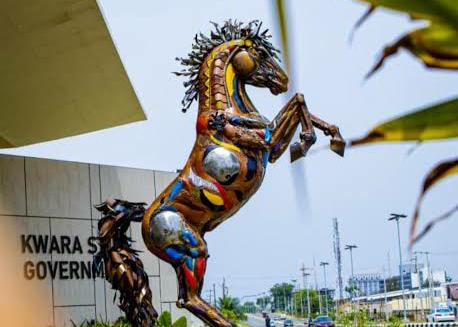
This only serves to complicate the mystery more, as now there is also an iconic statue of a horse placed outside the Government House. Such acts pose some fundamental questions about representation and identity. What does the horse stand for in relation to the varied cultures of Kwara State? How does it represent the interests of the farmer in Baruten, the trader in Offa, or the citizen of Edu? Is it possible that one single entity could be enough to represent such a diverse people? Even if the horse can be regarded as representing strength or nobility, strength in which aspect?
Kwara is historically known as a land of peace, coexistence, and enterprise, a state shaped by farmers, traders, and communities bound by harmony. Its identity lies not in abstract or imported symbols, but in the daily experiences of its people. Symbols that endure are those that emerge organically from this reality, symbols that resonate across communities, not just within corridors of power. Why a horse? That is the question many citizens are asking. What, or who does the horse truly represent? Are Kwarans known for horse rearing as a defining cultural or economic identity? If a man from Ilorin finds meaning in the horse, does that automatically extend to the man from Offa or the Sanchitagi man? At its core, the concern is simple yet profound: whose identity does the horse project in Kwara State? Should the preference or symbolism of one individual be elevated to define the collective image of an entire people? And even if we concede that the horse symbolizes strength, one must still ask, strength in what context, and for what purpose?
The search for identity is not wrong; indeed, it is necessary. But it must be a collective journey, rooted in consultation, reflection, and authenticity. A people’s symbol should not confuse them; it should speak for them. Until Kwara’s symbols begin to reflect the true essence of its people, the state may continue to drift, raising monuments that stand tall, yet say so little.
Uthman Qasim writes from Sanchitagi and can be reached via uthmanqasim5@gmail.com