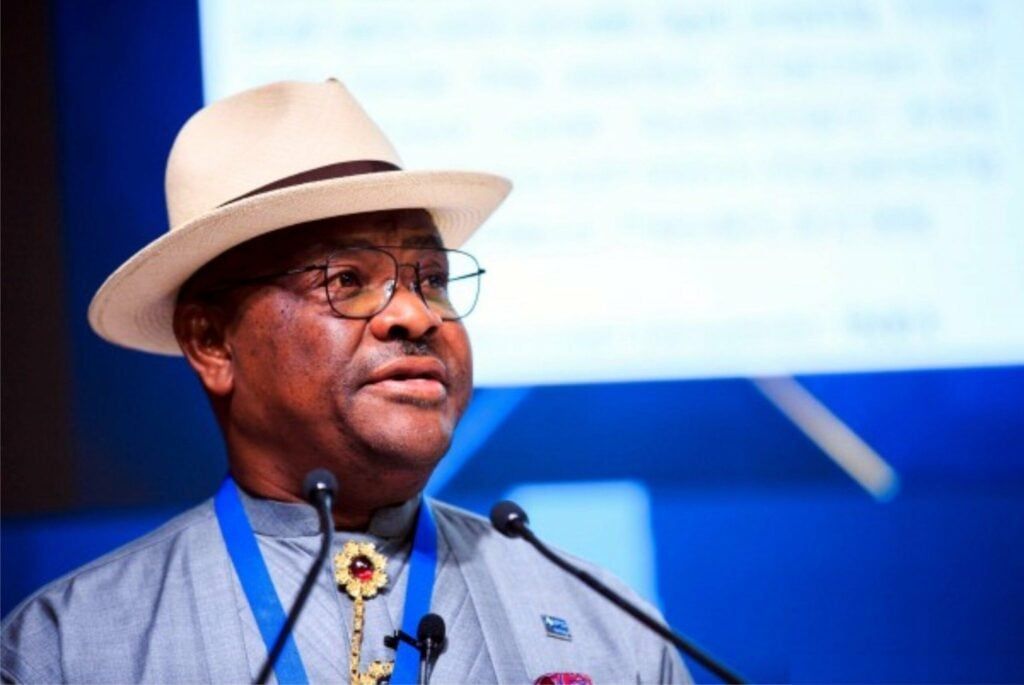
Tinubu’s leadership sets new standard for democratic dividends — Wike
The Minister of the Federal Capital Territory, Nyesom Wike, has declared that President Bola Tinubu’s leadership has established a new benchmark in delivering the dividends of democracy.
Wike made the assertion on Tuesday while presenting a Distinguished Personality Lecture titled, “The Impact of Political Leadership on Infrastructural Development in Nigeria: Between Dividends of Democracy and Good Governance,” at the Faculty of Social Sciences, University of Abuja.
According to the minister, the Tinubu administration has shown uncommon determination in tackling Nigeria’s longstanding structural challenges.
“One must acknowledge, with pride, the emergence of President Bola Tinubu as a leader who exhibits key attributes of purposeful and servant-oriented leadership,” Wike said.
He noted that Tinubu’s democratic credentials were firmly established long before he assumed office, citing his role in Nigeria’s pro-democracy struggle.
“As President, he signalled uncommon resolve from his first day in office by removing the fuel subsidy — a policy long acknowledged as economically destructive but avoided by successive administrations for lack of political courage,” he stated.
Although the decision sparked resistance and short-term hardship, Wike defended the reform, arguing that it has long-term economic benefits.
“While the reform has generated short-term pains and resistance, it has also freed resources for subnational development, halted the spiral of unsustainable debt, and initiated the difficult process of restoring market discipline to the energy sector,” he said.
The minister added that infrastructure development under the current administration is already producing visible outcomes.
“Even the sternest critic of President Tinubu will concede that Nigeria is witnessing tangible improvement in infrastructure,” he said, describing the Renewed Hope Agenda as a deliberate shift toward sustainable development.
Wike emphasised that democracy must extend beyond elections and political rhetoric to practical governance outcomes.
“Nigeria stands at a critical juncture where democracy must be re-examined not as a ritual, but as a responsibility; not as a slogan, but as a living system that must deliver tangible value to the people,” he said.
He stressed that democratic practice must reflect everyday accountability, transparency, and active citizen participation, warning that public confidence in governance depends on performance.
“Where democracy delivers infrastructure, it earns legitimacy; where it fails, it breeds cynicism,” he added.
Describing infrastructure as central to nation-building, Wike stated, “Infrastructure is not simply roads and bridges; it is the circuitry of nationhood.”
He also highlighted ongoing transformation in the Federal Capital Territory, saying Abuja’s development under his administration demonstrates the practical link between leadership and infrastructure delivery.
“Abuja is not merely a city; it is a national statement,” he said, adding that infrastructure in the FCT is treated as a right owed to citizens rather than a political favour.
Wike concluded by urging leaders at all levels to prioritise tangible outcomes over rhetoric.
“Nigeria’s future will not be secured by eloquence or promise alone, but by leadership that understands democracy as a continuous obligation rather than a periodic event,” he said.