
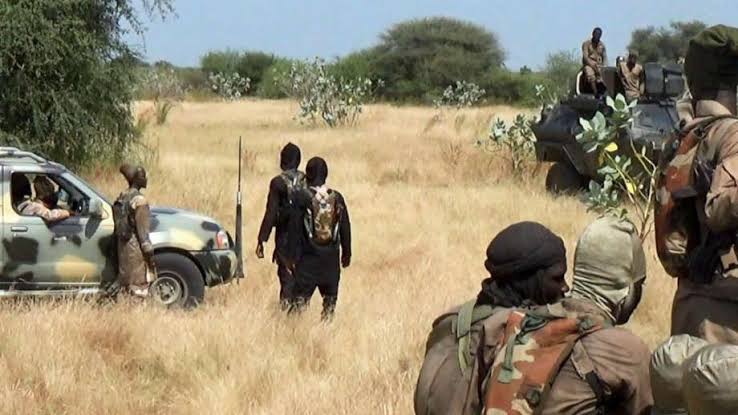
COLUMN | Between the barrel and the blindfold: Nigeria’s theatre of terror
By Abdulqadir M. Habeeb
Safety in Nigeria exists today as an idea rather than a condition. It circulates in rumours exchanged between gunfire, ransom calls, and hurried prayers. The country has reached a point where danger plans ahead, where fear schedules itself, and where survival feels like a private arrangement rather than a public guarantee.
Nigeria stands at a crossroads shaped by violence that behaves like a system rather than an interruption. Insecurity structures daily life. It dictates movement, shapes economic decisions, determines education outcomes, and rewrites social contracts. From the ideological battlegrounds of the northeast to the ransom forests of the northwest, the nation operates inside a theatre of terror. Its actors multiply while accountability evaporates.
This column examines how the country arrived at this point and why escape continues to feel elusive. The story stretches beyond insurgency. It extends into kinship, profit, governance failure, and the slow normalisation of fear.
The Insurgency’s Origins and Evolution
The Boko Haram insurgency began quietly as a sermon. Mohammed Yusuf framed Western education as moral contamination and positioned religious withdrawal as purification. His rhetoric attracted followers searching for certainty in an unequal society. His death in 2009 transformed grievance into vengeance. Persuasion gave way to compulsion. Dialogue dissolved into domination.
Under Abubakar Shekau, Boko Haram evolved into a cult of absolutism. The group elevated violence to doctrine and wielded fear as a pedagogical tool. Suicide bombings turned markets and mosques into battlefields. Villages disappeared overnight. The abduction of the Chibok schoolgirls etched Nigeria into global consciousness while exposing the fragility of state protection, as HumAngle documented extensively in its long-term reporting on the insurgency.
Shekau governed through terror directed both outward and inward. Fighters obeyed under threat of death. Civilians complied through terror conditioning. Negotiation carried the stigma of apostasy. His reign thrived on spectacle and intimidation, yet that same rigidity fractured the movement internally. Commanders defected. Civilians fled. Rivals organised.
When Islamic State West Africa Province challenged Shekau’s authority, his world collapsed inward. Cornered and isolated, he chose death through detonation rather than submission. His end mirrored his worldview: absolute violence consumed itself. HumAngle described this moment as the collapse of a terror cult rather than the end of terror itself.
Shekau’s death reshaped the insurgency without resolving it. ISWAP emerged with a different logic. Where chaos had reigned before, structure took root. Where terror had dominated, governance followed.
ISWAP imposed taxes, regulated markets, punished theft, and embedded itself within local economies. The group calibrated its violence strategically. It treated civilians as assets rather than expendable targets. Fighters trained systematically. Propaganda refined its tone. Territory mattered. Under Abu Musab al-Barnawi, ISWAP pursued legitimacy through predictability.
Communities living under its control described order replacing randomness. This order carried coercion, yet it contrasted sharply with state absence. Research from the Combating Terrorism Center at West Point shows how ISWAP evolved into a parallel authority capable of rivaling government presence in parts of Borno and Yobe.
This shift reflects the maturation of insurgency rather than its defeat. Military victories lose meaning when adversaries learn governance faster than the state learns reform.
Regional Dimensions and Fragmentation
Nigeria’s war extends beyond its borders. Jama’at Nusrat al-Islam wal-Muslimin operates across Mali, Burkina Faso, and Niger, linking local conflicts into a regional bloodstream of arms, fighters, and ideology. Reuters and Al Jazeera have repeatedly documented how the Sahel functions as a corridor where violence circulates freely.
JNIM facilitates training, arms movement, and ideological exchange. It connects Nigerian actors to transnational smuggling networks and operational blueprints. CTC West Point analysts describe how porous borders transform tactical victories into temporary illusions, allowing insurgency to regenerate from external sanctuaries with alarming efficiency.
Nigeria exists within this regional storm rather than beside it. The insurgency fractured further through figures like Mamman Nur. He embodied ideological tension within Boko Haram, valuing restraint as strategy. He pursued negotiation when leverage demanded it. He cultivated external alliances that expanded operational depth. His assassination in 2018 removed moderation from the equation and accelerated fragmentation, creating space for ISWAP’s structured rise, according to HumAngle profiles.
This internal fracturing enabled new operational models to emerge. Other leaders adapted geography into strategy. Bakura Doro operates across the Lake Chad Basin with fluid command structures that resist surveillance. Al Jazeera reporting highlights how marshlands absorb movement and dissolve borders under cover of mobility. His decentralised cells survive independently while maintaining ideological alignment.
Violence evolves through learning, and Boko Haram’s tactical development illustrates this principle clearly. Early attacks relied on crude explosives and ambushes. Tactical imagination expanded steadily. Suicide bombings shocked moral boundaries. The groups weaponised women and children as carriers of death, bypassing suspicion and magnifying trauma in patterns HumAngle documented extensively.
ISWAP refined the craft further. Drone reconnaissance entered the battlefield. Encrypted communications coordinated complex assaults. Fortified military positions fell to adaptive tactics. CTC West Point analysis shows how each evolution exposed static countermeasures and reactive doctrine.
The Criminal Economy of the Northwest
While ideology structured the northeast, profit structured the northwest. Banditry emerged initially through cattle rustling. Over time, it mutated into governance by gunmen. Forests in Zamfara, Katsina, Kaduna, and Niger transformed into sanctuaries where armed groups taxed farmers, abducted schoolchildren, and regulated access to land. SBM Intelligence data tracks this shift from criminality to parallel authority.
Banditry thrives on poverty, unemployment, and the collapse of traditional authority. In many communities, bandits settled disputes, provided protection, and redistributed wealth through ransom flows. HumAngle’s field reporting shows how victims and accomplices merged into survival networks. Ethnic grievances provided narrative justification. Historical neglect translated into moral cover. Where state presence faded, legitimacy became negotiable.
Kidnapping has become the economic engine binding these systems together. It functions as an industry rather than a crime. Negotiators, financiers, informants, and guards form supply chains. Armed groups price victims according to perceived wealth and political sensitivity, as SBM Intelligence reports detail.
Kuriga revealed this reality starkly. Families liquidated land and livestock to meet ransom demands. Generational assets vanished. Children returned bearing trauma that emptied classrooms months later, according to Premium Times investigations.
The Abuja-Kaduna train attack redefined vulnerability. Infrastructure once celebrated as progress became a corridor of terror. Premium Times published survivor accounts describing forced marches, deprivation, and negotiations conducted under immediate threat. Public confidence in modern systems fractured.
Greenfield University represented escalation through symbolism. The executions communicated deadlines and erased ambiguity. Negotiation acquired urgency. Nigerian media coverage widely analysed how this pattern established that kidnapping persists because consistency rewards brutality.
This violence carries economic consequences that ripple outward relentlessly. UN OCHA assessments show agricultural output across Zamfara and Katsina declining sharply as farmers abandoned fields. Transporters priced risk into every journey. Food inflation followed each attack. Fear imposed itself as an invisible tax paid daily by the poor.
The Dangerous Convergence
The most dangerous evolution emerges from convergence between jihadists and bandits. These groups discovered complementary strengths. Ideology offered moral camouflage. Criminal networks provided revenue. Kinship ensured loyalty. CTC West Point describes this fusion as a resilience engine rather than a temporary alliance.
In Zamfara, ISWAP operatives transferred expertise in explosive assembly to bandit cells in exchange for access to kidnapping pipelines. In Niger, Mamuda’s faction facilitated arms transfers in return for ransom equity. CTC research shows how these alliances thrived through pragmatism. Such hybrid threats resist categorisation and confound doctrine designed for singular enemies.
Psychological warfare underpins this entire architecture. Shekau mastered spectacle: burned villages and defiant sermons shattered morale before fighters arrived. ISWAP refined persuasion through displays of governance and selective justice. HumAngle documents how fear broke resistance while order seduced survival instincts. Communities calculate risk daily, and compliance becomes rational under sustained pressure.
The Architecture of Fear
Nigeria now exists in a space where fear circulates faster than truth and adapts faster than policy. Governance responds theatrically while survival decentralises. Parents track children. Communities fund vigilantes. Protection privatises itself. When authority fragments, legitimacy follows into the shadows.
What has emerged is not merely a security crisis but a fundamental reshaping of the social contract. Terror has found structure while governance has stalled. Fear has become systematised, predictable, and embedded in daily calculation. The question facing Nigeria is no longer simply how to defeat armed groups, but how to rebuild the legitimacy and presence that might render them obsolete.
Until the state offers communities a competing bargain built on consistent protection, predictable justice, and genuine inclusion, the theatre of terror will continue its performance. The actors may change, the tactics may evolve, but the underlying architecture of fear will persist.
‘Posterity shall vindicate the just’
Habeeb is a Tech, Strategy, and Innovations consultant based in Abuja. He keeps a periodic column here and can be reached via habeebajebor@gmail.com.
Sources Note: This column draws on reporting and analysis from HumAngle, the Combating Terrorism Center at West Point, UN OCHA, SBM Intelligence, Premium Times, Reuters, and Al Jazeera, alongside field observations and publicly available security assessments.